
A loose ball joint can start with a faint clunk and end with steering that feels off. That gap between “small noise” and “real problem” is why ball joint symptoms deserve attention.
Drivers often blame tires or alignment first. Sometimes they are right, but worn ball joints can mimic both and keep getting worse.
If your front end feels sloppy, here is how to spot the signs before the repair grows.
What a worn ball joint does to steering
Ball joints link the control arms to the steering knuckles, so your wheels can move up, down, and turn smoothly. When they wear out, that smooth motion turns into extra play.
The first clue is often a boot that is cracked, dry, or leaking grease. Once that seal opens up, dirt gets in and the joint wears faster. Over time, the wheel can shift a little every time the suspension loads and unloads.
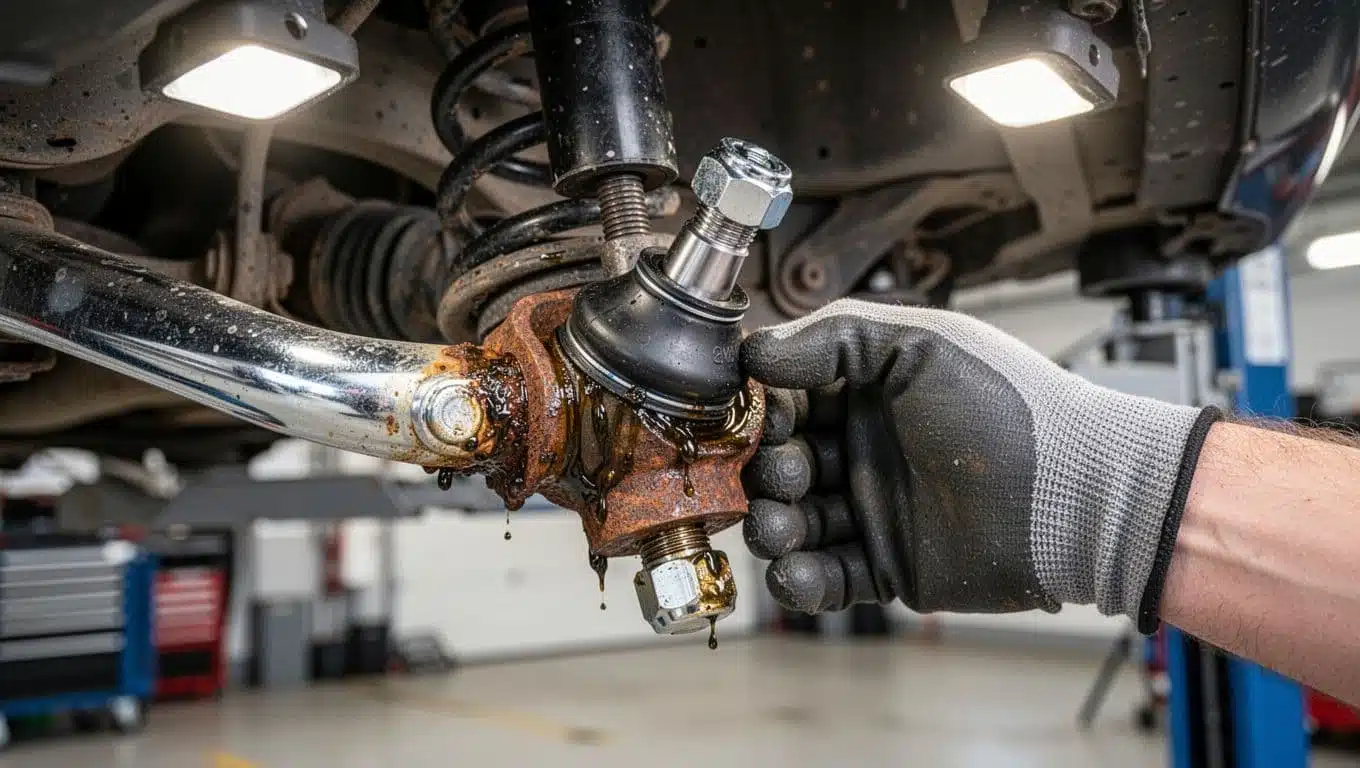
That movement may not look dramatic, but you can feel it in the steering wheel. A car that once tracked straight can start to wander, especially over bumps or during braking. Tire wear often shows up too, usually on the inside edge first.
A front end that feels loose often starts with one sound, then turns into a daily habit.
The earlier you catch it, the better. If the wear keeps going, the joint can affect alignment, tires, and other suspension parts. Then a simple fix turns into a bigger repair.
Ball joint symptoms you can hear and feel
Some ball joint symptoms show up on the road, not in the driveway. That is why a short drive can tell you more than a quick glance.

Listen for a clunk or knock when you go over a pothole, speed bump, or rough parking lot. A worn joint often makes that sound at low speed, then gets quieter on smooth pavement. You may also hear a creak or pop when you turn into a driveway.
Watch for steering that feels vague or needs constant correction. If you turn the wheel and the front end seems to hesitate, the joint may be adding play. That loose feeling is easy to miss at first because the car still moves, just not cleanly.
A few signs often show up together:
- Uneven tire wear, especially on the inside edge.
- Popping or creaking during slow turns.
- A pull or shake that shows up under braking.
- Steering that feels loose after hitting a bump.
If more than one of those shows up, the odds of front suspension wear go up fast. A fresh alignment won’t cure a loose joint, and it may not hold if the part keeps moving.
A quick home check can confirm the problem
You don’t need a full shop setup to spot obvious wear, but safety matters. Work on a flat surface, set the parking brake, and use jack stands if you lift the car.

Start with a visual check. Look at the ball joint boot, the control arm, and the area around the joint. If you see torn rubber, wet grease, or heavy rust, treat that as a warning sign. The joint may still hold together, but it is already wearing.
Then move to a basic play check:
- Park on flat ground and secure the car.
- Inspect the boot and nearby metal for grease or cracks.
- Lift the front end safely and support it with stands.
- Grab the tire at 12 and 6 o’clock, then rock it in and out.
- Compare both sides so you can spot unusual movement.
Any clunk, shift, or visible movement deserves a closer look. If the tire moves but the steering wheel does not, that can point to a joint or another suspension part.
A pry bar can help a trained eye spot movement at the joint, but don’t force parts if you’re unsure. A wheel bearing, tie rod, or control arm bushing can make similar noises. The job is to find the source, not guess at it.
If the movement is obvious, stop there. Driving on a questionable front end can make the problem harder to track later.
Test drives, used cars, and when to stop guessing
Ball joints can hide during a calm drive, then show up the moment the road gets rough. That matters when you’re looking at used cars for sale Lodi WI or checking out a car you already own.

During a test drive, pay attention to low-speed turns, braking, and uneven pavement. A front end that knocks over bumps or feels loose in a lane change deserves a closer look, even if the car still drives straight. Try a tight parking-lot turn too, since worn joints often make themselves known when the suspension loads one side.
This is where car maintenance Lodi Wisconsin drivers rely on can make a real difference. Routine inspections catch wear before the tires get chewed up or the steering starts to drift. That matters whether you drive every day or you are comparing a used car against a few other options.
If the steering starts to wander or the noise gets sharper, don’t push the car farther than you need to. A bad joint can turn a short drive into a roadside problem. At that point, 24 hour towing Lodi Wisconsin drivers count on becomes the safer choice, and a towing service Columbia County WI motorists can trust keeps the car moving without added risk.
Getting the right repair help
A good suspension check does more than swap parts. It looks at both sides, checks for related wear, and confirms whether the ball joint is the real source of the noise.
If you want a full-service auto repair shop in Lodi, look for clear answers and a crew that explains the difference between a worn joint, a damaged bushing, and a bad alignment. That kind of detail saves time and keeps repairs focused.
For a closer suspension check, local auto repair services in Lodi can help sort out whether the front end needs a ball joint, steering work, or another fix. That matters if you are comparing auto repair Lodi WI options or searching for a mechanic near Lodi WI. A steady diagnosis is better than a fast guess.
It also helps when you want to keep a vehicle in good shape after a purchase. Smart buyers and owners both know that small front-end issues get expensive when they are ignored. Tires wear faster, the ride gets rougher, and the steering never feels quite right.
Catch ball joint trouble early
Ball joint problems usually speak up before they fail. Clunks, loose steering, uneven tire wear, and torn boots are the signs that deserve your attention.
If your front end feels off, trust that feeling. A quick inspection now can save you from bigger suspension damage later, and it can also keep the car safer on the road.
When you need help with a check, a repair, or a roadside problem, Contact Us Today and get the issue looked at before it grows.