
A click when you turn the key can sound like a clear verdict, but it isn’t. To test starter solenoid operation before buying a replacement, you need to check the battery, connections, and signals that make the starter work.
One sound can’t identify one failed part. A weak battery or corroded cable can produce much the same no-crank complaint as a faulty solenoid. Start with the checks you can make safely, then use a meter to narrow down where power stops.
What the starter solenoid does
On many vehicles, the solenoid sits on the starter assembly. When it receives a start request, it moves the starter drive into position and closes contacts that feed power to the starter motor. The motor then turns the engine.
Some vehicles also have a separate starter relay in a fuse box. That relay and the solenoid have different jobs, even though either can make a click. A relay click doesn’t prove the solenoid received power, and a solenoid click doesn’t prove its contacts carried enough current.
The sound pattern is still useful. Rapid clicking often points toward low voltage or a poor connection. One firm click may put the starter assembly higher on the list. Silence can point to a control-circuit problem, but none of these sounds confirms a failed solenoid by itself.
Prepare for a safe, vehicle-specific test
Starter wiring carries high current. The large battery-feed terminal on a starter can remain live with the key off, so treat exposed terminals as energized until you’ve verified otherwise.
Find the right diagram first
Look up the starter circuit for your vehicle’s year, make, model, and engine. Identify the battery feed, the solenoid’s small control terminal, the motor connection, and any separate relay. Terminal locations and access differ between vehicles.
DENSO’s starter-system diagnosis guidance describes a general approach and directs readers to original-equipment information. Use the vehicle’s service procedure for connector locations, test conditions, and acceptable readings rather than applying a number from another car.
Set up without creating another problem
Park on level ground, set the parking brake, and select Park or Neutral as appropriate. Keep clothing, meter leads, and hands clear of moving parts. Never work beneath a vehicle held up only by a jack.
Use a meter set to DC volts for live-circuit checks. Don’t place it in current mode across the battery, and don’t measure resistance on an energized circuit. Avoid bridging starter terminals with a screwdriver. If reaching a terminal requires working near moving parts or cramped wiring, leave that test to a shop.
Rule out battery and cable trouble first
Testing the solenoid won’t settle much if the battery can’t supply the starter. Battery power must travel through cables and connections, then return through the engine ground path. A weak point anywhere along that route can produce a click without cranking.
Check the battery’s condition
Look for weak headlights, dimming dash lights, or a crank that gets slower with each attempt. These are clues, not a load test. An unloaded battery reading can look reasonable even when the battery struggles under starter demand.
If the battery is discharged, charge and test it before judging the solenoid. A successful jump-start points toward the battery, connections, or charging system, but it doesn’t identify which one failed. For a fuller comparison, see how to tell battery and starter problems apart.
Inspect the entire connection path
Check battery clamps for looseness and white or green corrosion. Follow the heavy positive cable toward the starter and inspect visible insulation and connections. On the return side, look for a damaged battery negative cable or loose engine ground strap.
Disconnect the battery as directed by the vehicle procedure before cleaning or tightening connections. Regular car maintenance in Lodi, Wisconsin, can include battery and charging checks before winter makes a marginal connection harder to ignore.
How to test starter solenoid operation with a meter
Once the battery and visible connections check out, a meter can help separate a missing start command from a problem at the starter. These checks require access to the correct terminals and a safe way to observe readings during a start request.

Verify the control signal
The small solenoid terminal typically receives a signal when you turn the key or press the start button under the right conditions. With the meter in DC-voltage mode, test that terminal against the ground point specified by the wiring diagram during a start request.
If the expected signal never arrives, replacing the solenoid is premature. The fault may lie in a fuse, separate relay, ignition switch, wiring, security system, or Park/Neutral control. A scan tool may be needed on vehicles that use modules to authorize starting.
When you test starter solenoid control, compare the result with the vehicle’s procedure. Don’t assume every small terminal should show battery voltage at all times.
Confirm the battery feed reaches the starter
The large solenoid input should have a reliable supply from the battery. Check the connection and follow the specified test procedure rather than relying on a key-off voltage reading alone. A cable can show voltage without carrying starter current well under load.
If the control signal arrives and the battery feed is sound, yet the motor doesn’t turn, the solenoid or starter assembly deserves closer testing. That result still isn’t permission to order a solenoid without checking the output path and ground.
Check voltage drop under load
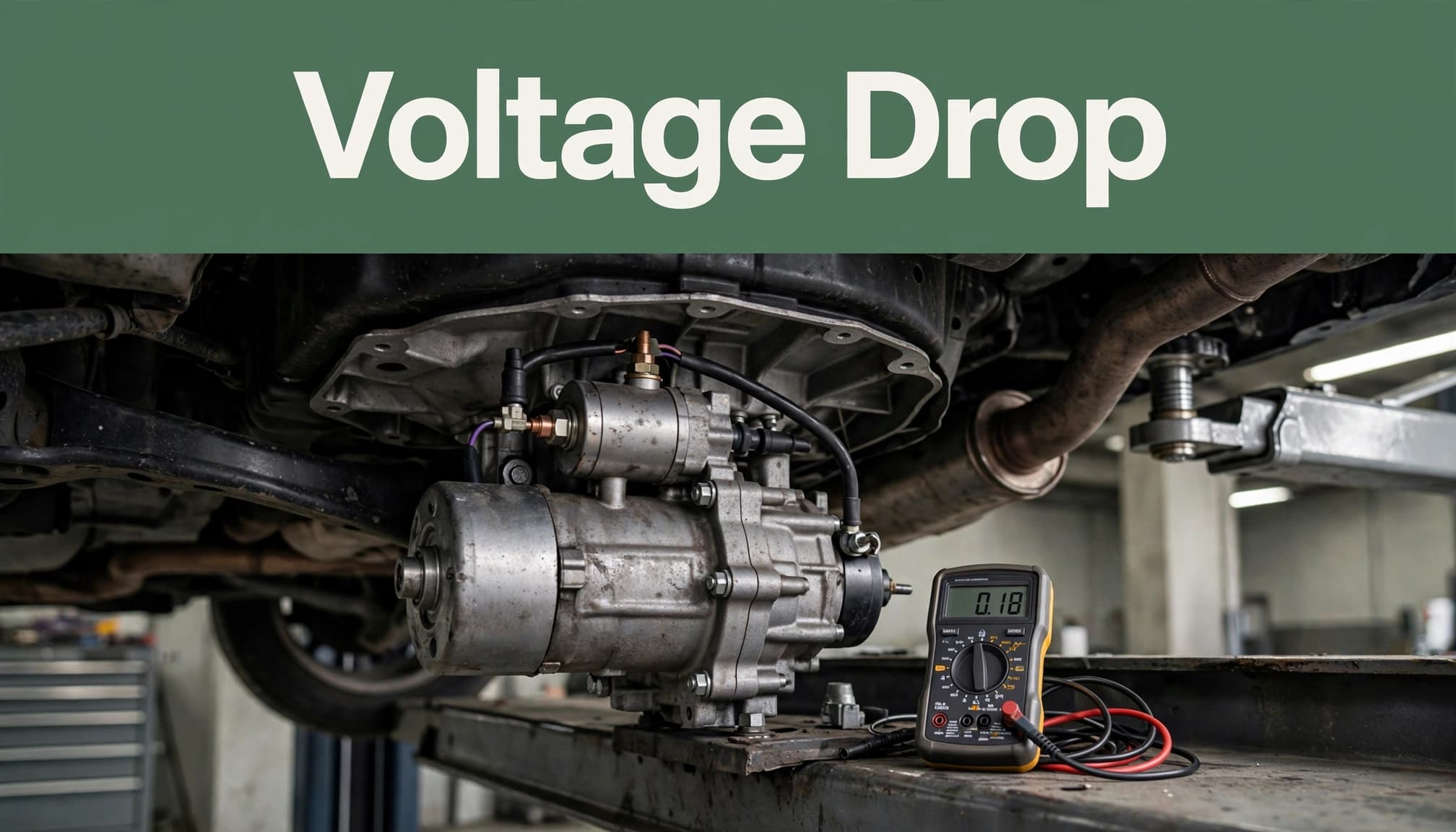
A voltage-drop test measures how much voltage a connection or component loses while current flows. It can reveal resistance that a simple continuity check misses. Fluke’s guide to starter-circuit voltage drop explains the method with a multimeter.
Follow the positive and ground paths
A technician can measure across sections of the positive path, including battery connections, cable ends, and the solenoid contacts, under the test conditions the vehicle maker specifies. DENSO’s starter troubleshooting guidance includes a check between the positive battery terminal and its cable connection while cranking.
The ground side matters too. Voltage lost between the starter housing or engine and the battery negative post can point to a poor return connection. Compare each reading with the vehicle’s specification and the conditions used to take it.
Don’t confuse a contact fault with a cable fault
If a test shows excessive loss across the solenoid contacts while the control signal and battery feed are correct, worn contacts become a stronger possibility. Excessive loss in a cable or ground connection points elsewhere.
Cranking procedures need care. Some tests call for preventing the engine from starting; DENSO’s starter troubleshooting reference discusses disabling fuel or ignition for certain checks. Follow the complete vehicle-specific procedure, including its cranking instructions, rather than mixing steps from different tests.
Read the results before replacing parts
A useful diagnosis connects the symptom to measurements. The table shows where each finding should direct your attention, not a replacement verdict.
| What you find | What to check next |
|---|---|
| Rapid clicking or slow cranking | Battery condition, cable connections, and grounds |
| No control signal at the solenoid | Relay, fuse, switch, wiring, and start authorization |
| Control signal present, but poor starter feed | Positive cable and its connections under load |
| Sound feed and control, but no motor operation | Solenoid contacts, starter motor, and ground path |
A single heavy click with bright dash lights may raise suspicion about the starter assembly. However, lights require far less current than a starter motor. They don’t clear the battery cables or ground.
A solenoid click tells you something moved. It doesn’t tell you whether the contacts delivered power to the motor.
If the engine cranks normally but won’t run, move away from solenoid testing. The starter has already done its main job, so fuel, ignition, or another engine-control issue needs attention. Repeated start attempts won’t turn a no-crank diagnosis into a reliable one; they can drain the battery and heat the starter.
Decide what needs repair
A confirmed fault across the solenoid doesn’t always mean you can replace that piece alone. Service options depend on the starter design and available parts. In other cases, the repair may be a cable connection, relay, or complete starter assembly.
For auto repair in Lodi, WI, ask for the findings behind the recommendation: battery test results, control-signal checks, and loaded circuit readings. A mechanic near Lodi, WI, should be able to explain which part failed and which nearby causes were ruled out. Lodi Shell’s electrical-system and auto repair services include diagnosing starter concerns.
If repair costs raise questions about keeping an older vehicle, compare the estimate with the car’s overall condition. That decision is separate from the diagnosis. Shopping for used cars for sale in Lodi, WI, makes more sense after you know whether the no-start requires a small connection repair or a larger job.
Get help if the car can’t be moved safely
Stop testing if you notice smoke, a burning smell, damaged insulation, or grinding. Roadside shoulders and severe weather aren’t places to probe starter wiring. Move to a safe location and arrange help instead.
Lodi Shell offers 24-hour towing near Lodi when a vehicle won’t start. A towing service in Columbia County, WI, is also a sensible choice when another start attempt would leave you exposed beside traffic. For repair or roadside help, Contact Us Today.
Key Takeaways
- A click is a clue. Check the battery and connections before blaming the solenoid.
- Confirm the control signal and battery feed, then use vehicle-specific voltage-drop tests to locate resistance.
- Replace a part only after the measurements point to it. Get professional help when access or roadside conditions make testing unsafe.
Frequently Asked Questions
Can I test a starter solenoid without removing it?
Often, yes. In-vehicle voltage checks can show whether the solenoid receives its control signal and battery feed. Access varies widely, though. If the terminals are difficult to reach safely, a shop can test the circuit with the vehicle properly supported.
Does one click mean the solenoid is bad?
No. One click can occur with a weak battery, poor cable connection, faulty solenoid contacts, or a starter motor problem. Check the supply and ground paths before choosing a replacement.
Should I replace the relay and solenoid together?
Not based on the noise alone. A separate starter relay controls a different part of the circuit. Test for the start signal at the solenoid and trace a missing signal back through the relay and its control circuit.
Conclusion
A no-crank click feels decisive until you trace the electricity behind it. Test the whole starting path before replacing the solenoid: battery, cables, control signal, contacts, and ground.
The right repair is the one the measurements support. That may be a solenoid, a starter assembly, or a connection that never needed a new part.